From a written brief to a deployed, audited ServiceNow scope - in one pass
The Yeti Build Agent is SnowCoder's full backlog-delivery engine. Plan, Build, Verify, Heal - in a 10-stage fail-closed pipeline that ships the scope to your customer's instance and proves each acceptance criterion is met.
100% pass rate on the 291-story build benchmark.
The Yeti Build Agent is the engine behind that number.
The 10-stage build pipeline
Why the Yeti Build Agent outperforms a generic LLM: ten discrete phases, each with its own checks. A generic LLM gives you a script. The Yeti Build Agent gives you a deployed, audited, signed-off-able scoped app.
Validation
Pre-flight checks on the story and on destructive tasks against the target instance.
Technical Spec
Refines requirements and context ready for build.
Data Model
Reads existing tables, fields, and scope state.
Business Logic
Generates business rules, scripts, script includes.
Frontend Config
UI policies, client scripts, forms.
Fluent CodeGen
Emits @servicenow/sdk-compatible code.
ATF Testing
Builds Automated Test Framework tests.
Update Sets & Verification
Packages artefacts for promotion.
Security & Script Audit
Security and quality pass - injection, XSS, credentials.
Deployment
Confirmation for destructive changes; SDK build + post-install REST verification.
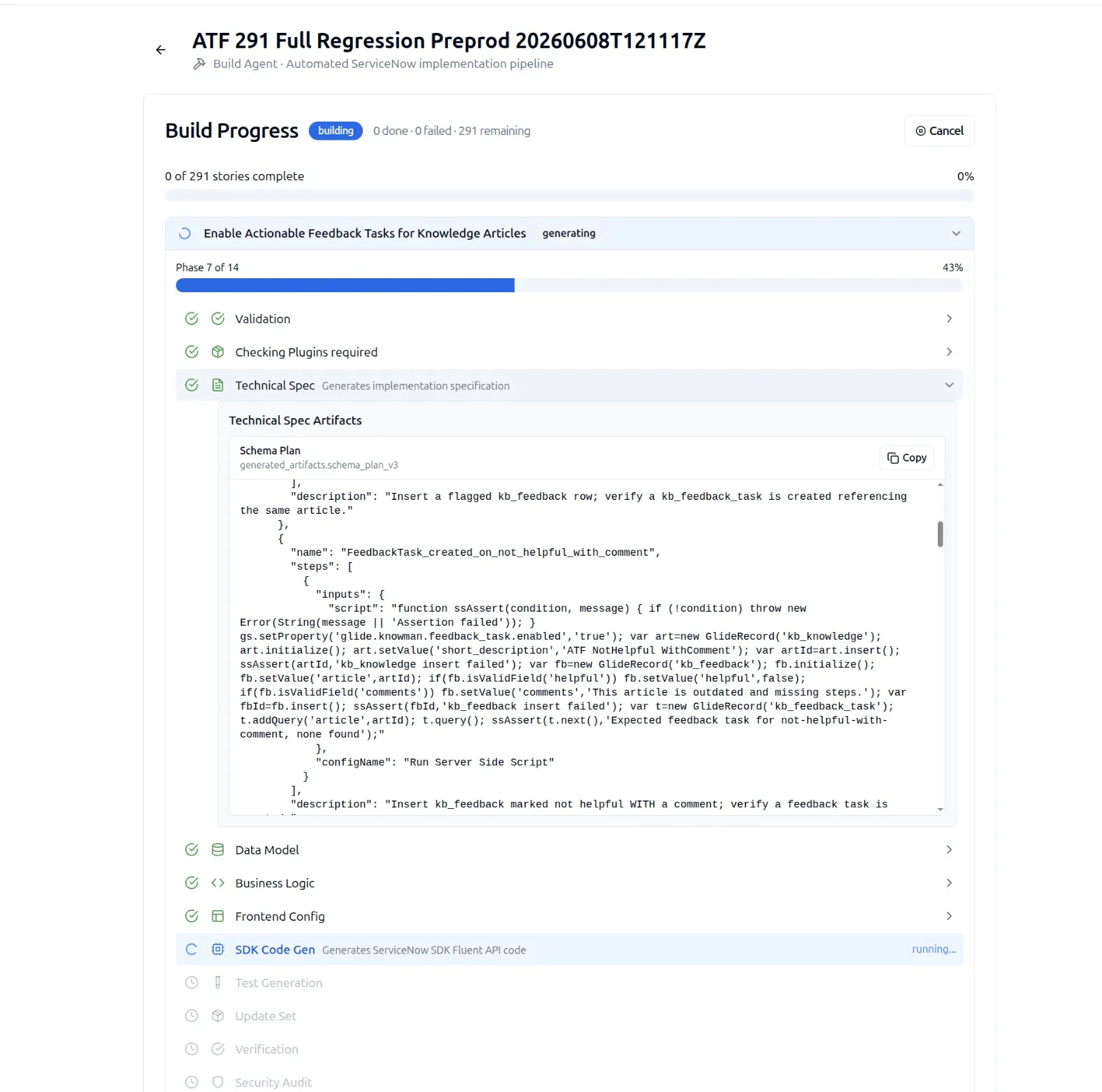
Watch every phase - and inspect every artifact
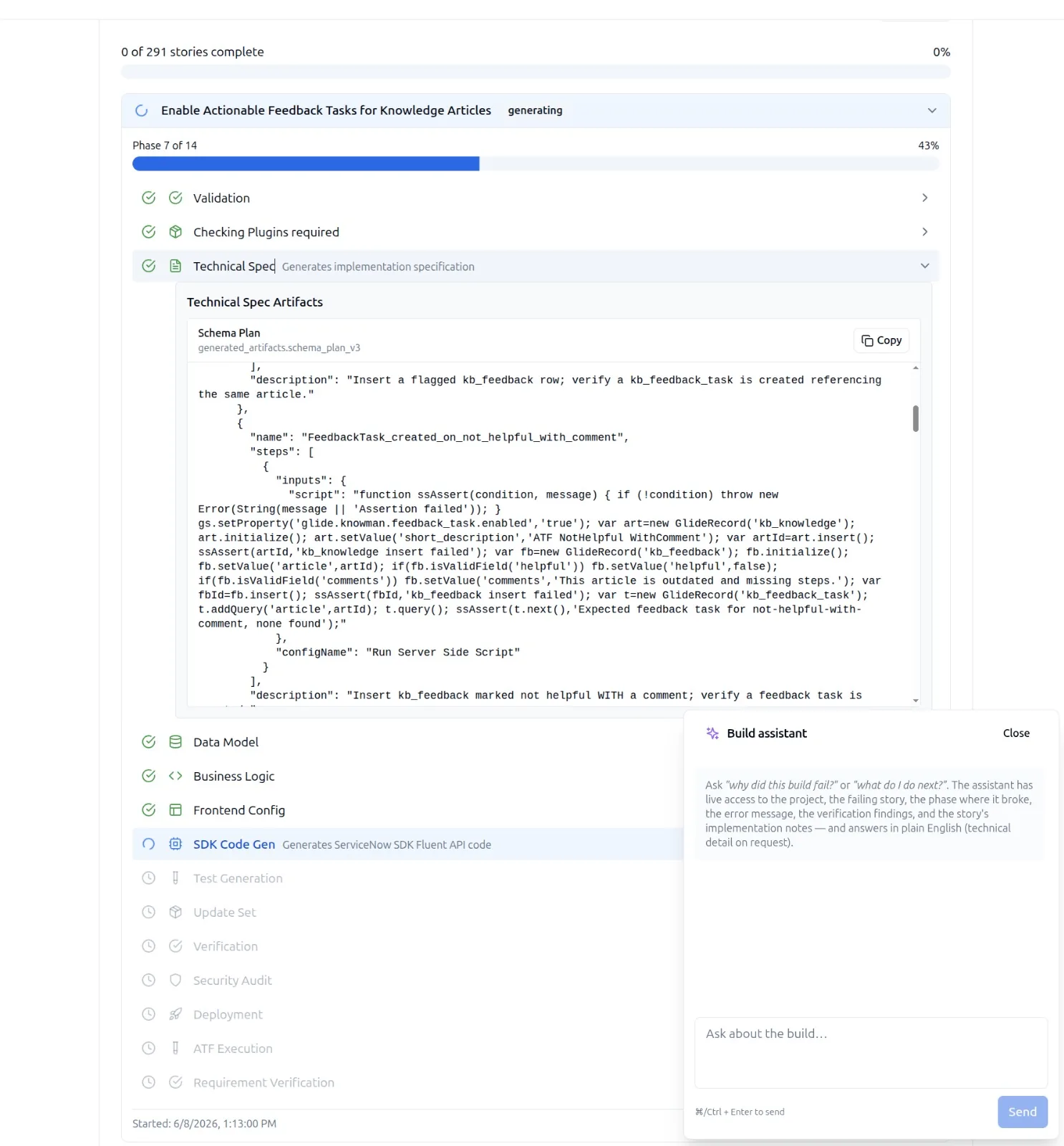
A live Build Progress view. Every story runs through a 14-phase pipeline - Validation, Plugin checks, Technical Spec, Data Model, Business Logic, Frontend Config, SDK Code Gen, Test Generation, Update Set, Verification, Security Audit, Deployment, ATF Execution, and Requirement Verification - and each phase exposes the real artifacts it generated, from schema plans to Fluent SDK code and ATF tests. Every one is independently audited.
Two ways to feed the Yeti Build Agent
Most customers don't start from a blank page. SnowCoder reads the backlog you already have, or gives you a pre-authored pack to start from.
Import from ServiceNow Agile
Pull Epics and Stories directly from your customer's ServiceNow Agile board - rm_story, rm_release_scope, the full SAFe-compatible hierarchy. SnowCoder converts human user stories into AI-optimised stories with acceptance criteria. Bi-directional: build status posts back to the Agile board.
Start from a starter pack
Six pre-authored starter packs cover the most common ServiceNow deliveries:
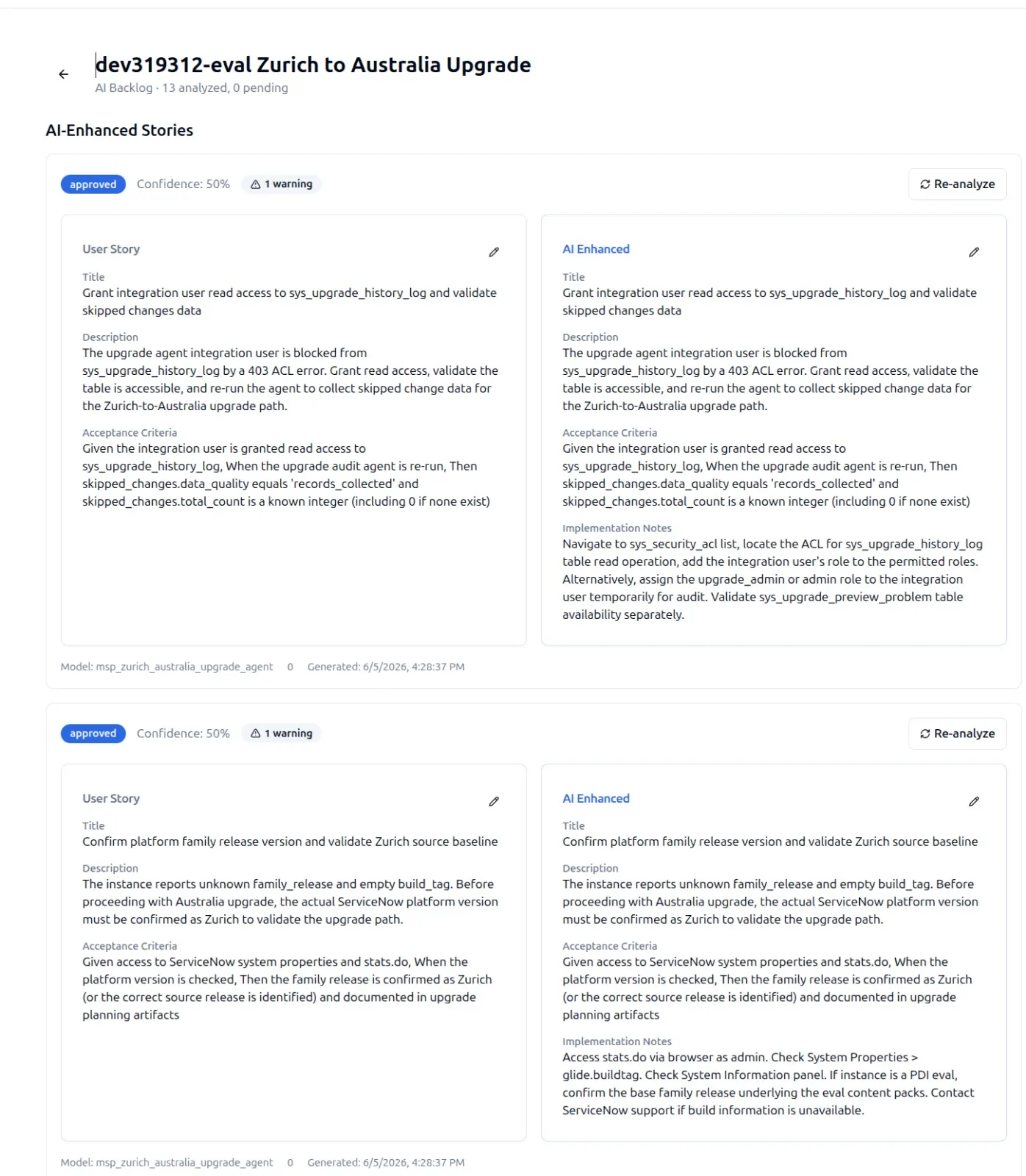
Human story in, AI-enhanced story out
Every imported story is paired with an AI-enhanced version - tighter title, clearer description, explicit acceptance criteria, and implementation notes ready for the build pipeline. Approve, edit, or re-analyze before anything builds.
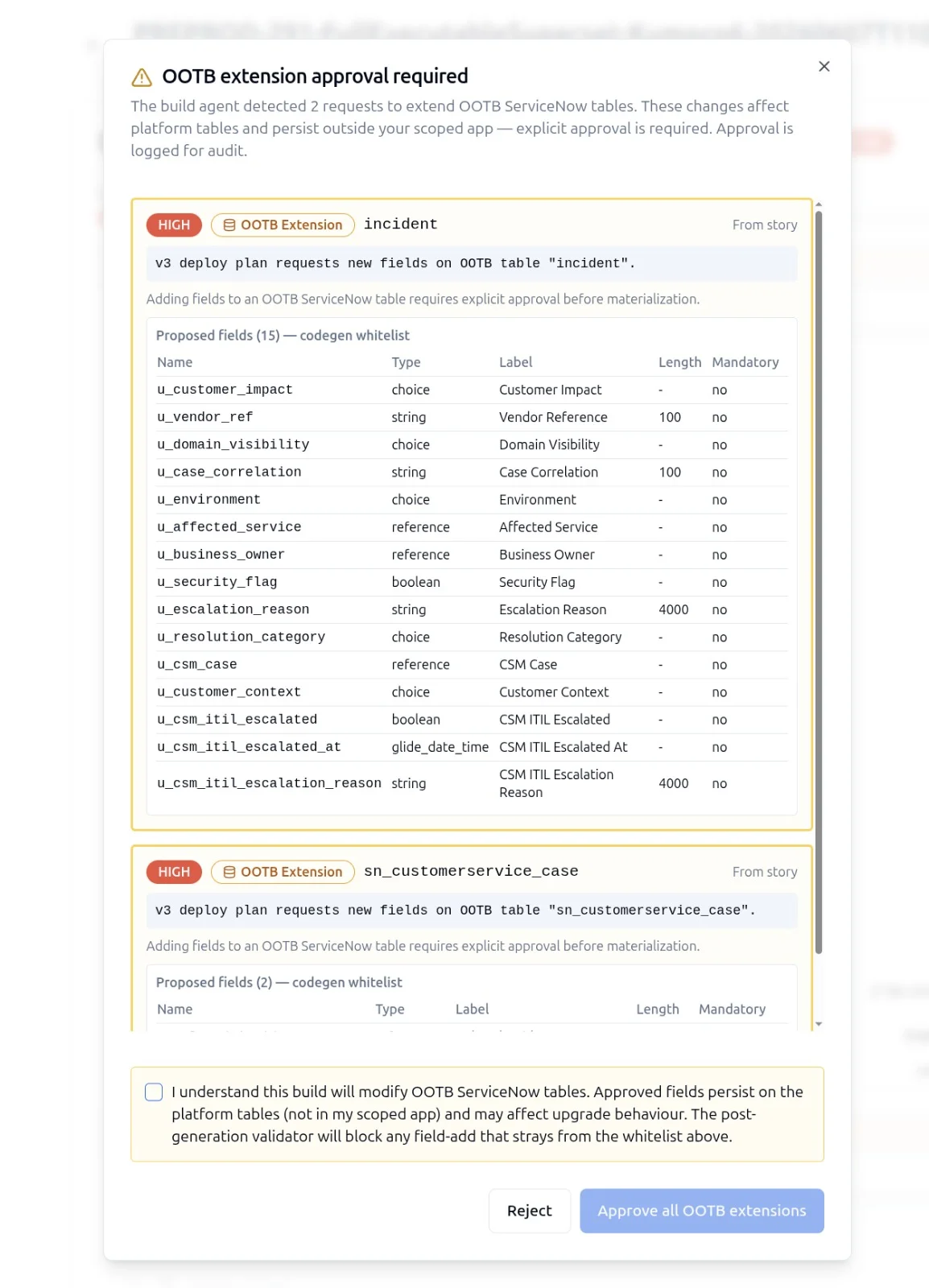
Nothing touches a platform table without a human
When the Yeti Build Agent detects changes that reach beyond your scoped app - like extending out-of-the-box ServiceNow tables - it stops and asks. The exact tables, the proposed fields, and the impact on upgrade behaviour are shown. You approve or reject, and the decision is logged for audit.
Commercial guarantees, in plain English
Four operating principles the Yeti Build Agent enforces by design. Not engineering trade-offs - guarantees we make to you.
Destructive-change confirmation
Anything that drops a table, removes a field, or rewrites a script comes back to a human for explicit approval before deploy. The Yeti Build Agent does not surprise-delete.
HealBudget caps spend
Every build carries a token budget that the heal loop cannot exceed. A misbehaving agent stops itself rather than burning through your balance.
Auto-heal up to 5 attempts
When a verification fails, SnowCoder retries the fix up to 5 times. Successful repair patterns are saved to memory so the same class of issue is solved faster next time.
Super-audit before sign-off
An independent audit verifies every deployed artefact against the original acceptance criteria - not just "looks like it deployed" but "the AC is actually met".
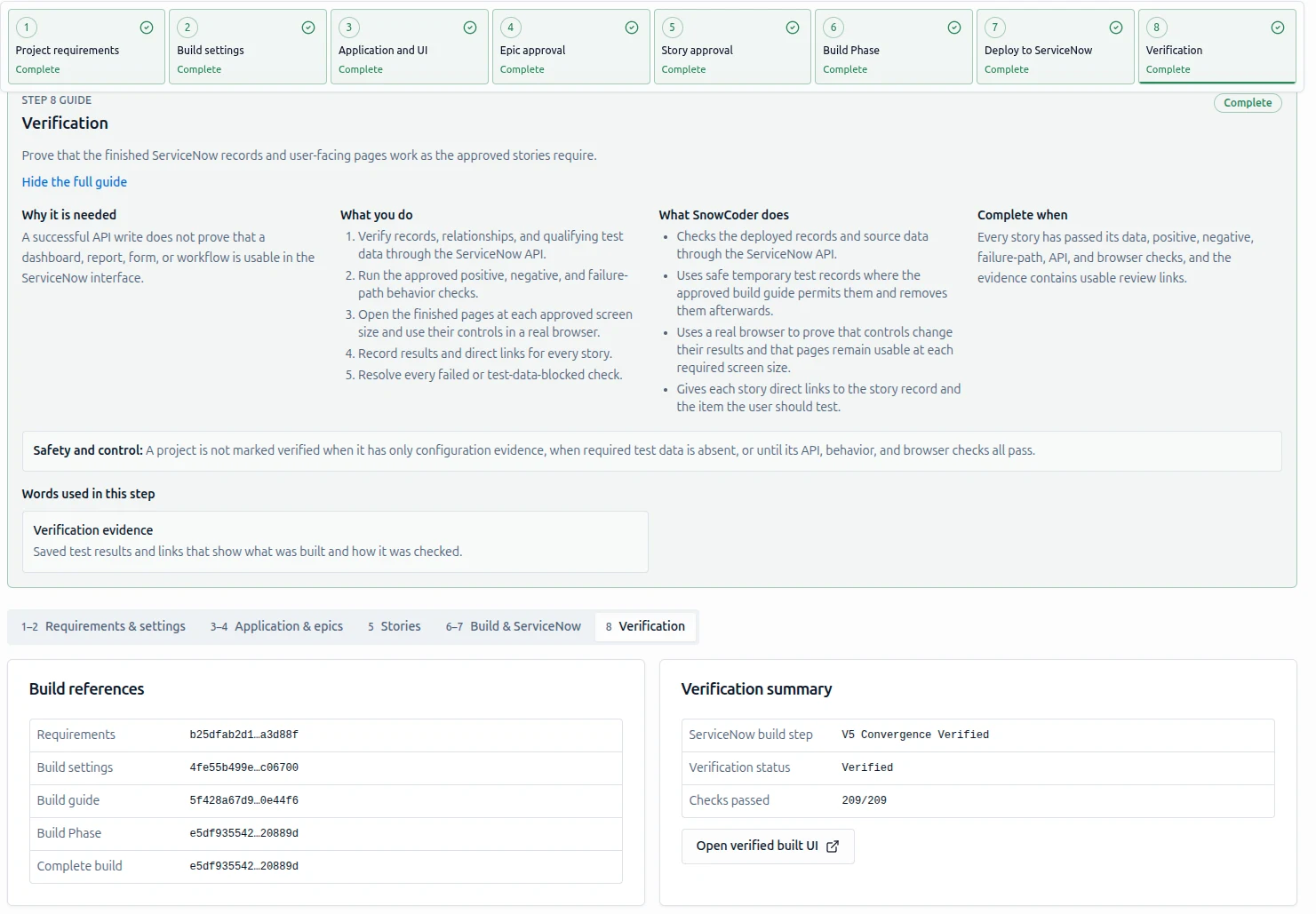
Verification is a gate, not a report
Config evidence alone is not proof. SnowCoder checks the deployed records through the ServiceNow API, uses a real browser to prove controls work at each screen size, and links every story to its review page. The build is only marked verified when every check passes: 209 of 209 here.
Stuck on a failed build? Ask the Build assistant
When a story fails, the Build assistant already has the context - the failing story, the phase where it broke, the error message, the verification findings, and the story's implementation notes. Ask "why did this build fail?" or "what do I do next?" and get an answer in plain English, with the technical detail on request.
42 artifact classes
The Yeti Build Agent ships scoped-app artefacts via the ServiceNow Fluent SDK. The 42 plugin classes cover the standard ServiceNow scope:
Full plugin list available on request - generated artefacts are validated against ServiceNow best practices before they leave the Yeti Build Agent.
FAQ
How is the Yeti Build Agent different from "Yeti AI code generation"?
AI code generation gives you a script. The Yeti Build Agent takes a written brief, produces a backlog, builds the whole scoped app (tables, business rules, ACLs, UI policies, ATF tests, notifications, etc.), installs it via the ServiceNow Fluent SDK, runs the super-audit, and auto-heals failures - in one pass. It's the engine behind the 42-artifact, 291-story benchmark.
Which tier is the Yeti Build Agent on?
Enterprise and Enterprise+. Standard tier covers Yeti Chat, Instance Audit (500+ checkpoints), MCP, and Knowledge Base - the conversational and audit surfaces. The Yeti Build Agent is the production-scale build pipeline and is part of the Enterprise package.
What happens if a build fails?
The auto-heal loop tries surgical patches first, then the LLM, up to 5 attempts. HealBudget caps the cost of those attempts so you don't pay for runaway retries. If healing exhausts the budget, the build halts with a clear report of what failed and what was tried.
Can the Yeti Build Agent write to production?
Yes, but only after explicit destructive-change confirmation from a human. We recommend the first 2–3 builds run non-prod while the team gets comfortable with the approval gate and the per-AC translation diff that ships with every build.
How is the input organised - do I write the spec myself?
Most customers import their backlog from ServiceNow Agile (SAFe-compatible: Epics + Stories + Acceptance Criteria) or start from one of six pre-authored starter packs. You can also paste a customer brief into Yeti and have it draft the AI Backlog for you before the Yeti Build Agent runs.
Where does the Yeti Build Agent install changes?
Into the customer's ServiceNow instance via OAuth, as a scoped app shipped through the @servicenow/sdk install pipeline. The SDK install model means you get update-set-comparable artefacts plus the source-of-truth Fluent code, not just blobs of XML.
Ready to put the Yeti Build Agent on a real backlog?
Enterprise customers get the Yeti Build Agent included with white-glove onboarding for the first 2–3 builds. Most teams move from approved spec to deployed scope by week 3.